
RGMS
Ruggedized GNSS Management System
An OCXO oscillator disciplined by a GNSS receiver hardened against jamming and spoofing. When the signal drops, holdover takes over and the platform's frequency reference and time outputs carry on.
A lost signal can be managed. A false one deceives.
Jamming is a visible outage. Spoofing goes unnoticed — which is exactly what makes it the greater risk.
The signal is drowned out.
The receiver loses lock and reports it. The system moves into a protected state rather than a wrong one.
The signal is counterfeited.
The receiver goes on reporting position, time and status as valid. Corrupt data leaks quietly into radar tracks, firing solutions and logs. Afterwards, establishing which data was correct becomes very difficult.
Four lines of defence
Multi-constellation support
GPS, GLONASS, Galileo and BeiDou are received concurrently. The receiver's spoofing-detection algorithms depend directly on that multi-constellation data — counterfeiting one system is not enough; an attacker would have to produce every constellation consistently.
L1/L2 dual-band reception
Common spoofing attacks typically counterfeit the civil L1 band only. Receiving both bands concurrently forces an attack to produce both consistently.
Detection, alerting and event logging
The receiver's built-in detection reports jamming and spoofing status at every navigation update; RGMS presents it through alarms, the web interface and SNMP, and writes it to a persistent event log. In a fixed installation the antenna position is known, so inconsistencies surface faster; GNSS time is also cross-checked against the OCXO and the RTC.
Autonomous holdover
Rejecting a suspect signal only means something if an independent local reference exists. The moment the system cuts the signal, the NMEA, IRIG-B and PTP time outputs carry on autonomously from the OCXO. The SC-cut OCXO holds ±30 ppb stability across the operating temperature range.
One common time reference across the platform
Radar, electronic warfare, datalink, command and control and logging all depend on precise timing. Drift between separate time sources degrades sensor correlation and makes root-cause analysis impossible.
A phase-coherent frequency reference, so chains that depend on coherent processing all work from the same phase source.
The standard time code used by field-proven equipment; it integrates directly, with no infrastructure change.
Sub-microsecond network synchronization.
Keeps event logs on a common time axis, which is what post-mission analysis is built on.
For subsystems that need precise pulse-level triggering.
All of these interfaces are driven simultaneously from one central unit, consolidating subsystems of different generations and vendors onto a single time axis.
Designed to military and airborne standards
The chassis, power stage and interfaces were worked against military environmental and electromagnetic compatibility requirements. The airborne configuration was additionally assessed under RTCA DO-160G.
Conforms to the military environmental test standard for temperature, altitude, shock, vibration, humidity and dust. RGMS is built to keep operating in the harshest conditions.
The electromagnetic interference and susceptibility standard. RGMS shares a platform with radar, radio and navigation systems without introducing interference.
Designed to conform to the environmental conditions and test procedures defined for airborne equipment.
Applied levels and categories, along with measurement reports, are shared on datasheet request.
One box, three operating environments
The 120 × 64 × 150 mm bracket-mounted chassis goes into a ship, an air platform or a tactical vehicle the same way, without a separate variant for each.
Uninterrupted time reference through MIL-STD-810H shock and vibration for armoured vehicles, tactical field and mobile command systems.
A common time and frequency source for radar, navigation and communications aboard ships and naval platforms, in a chassis built for salt fog, humidity and vibration.
A compact bracket-mounted chassis designed to meet RTCA DO-160G for air platforms and ground stations — 1.4 kg, with a wide 9–48 VDC supply range.
For fixed-site and centralised installations the same timing core is also offered in a 19" 1U rack chassis. That is a separate product, not an accessory to the bracket-mounted unit.
Technical Specifications
Interface, timing and compliance figures. Contact us for the full datasheet.
Inputs & Outputs
The hardware as built
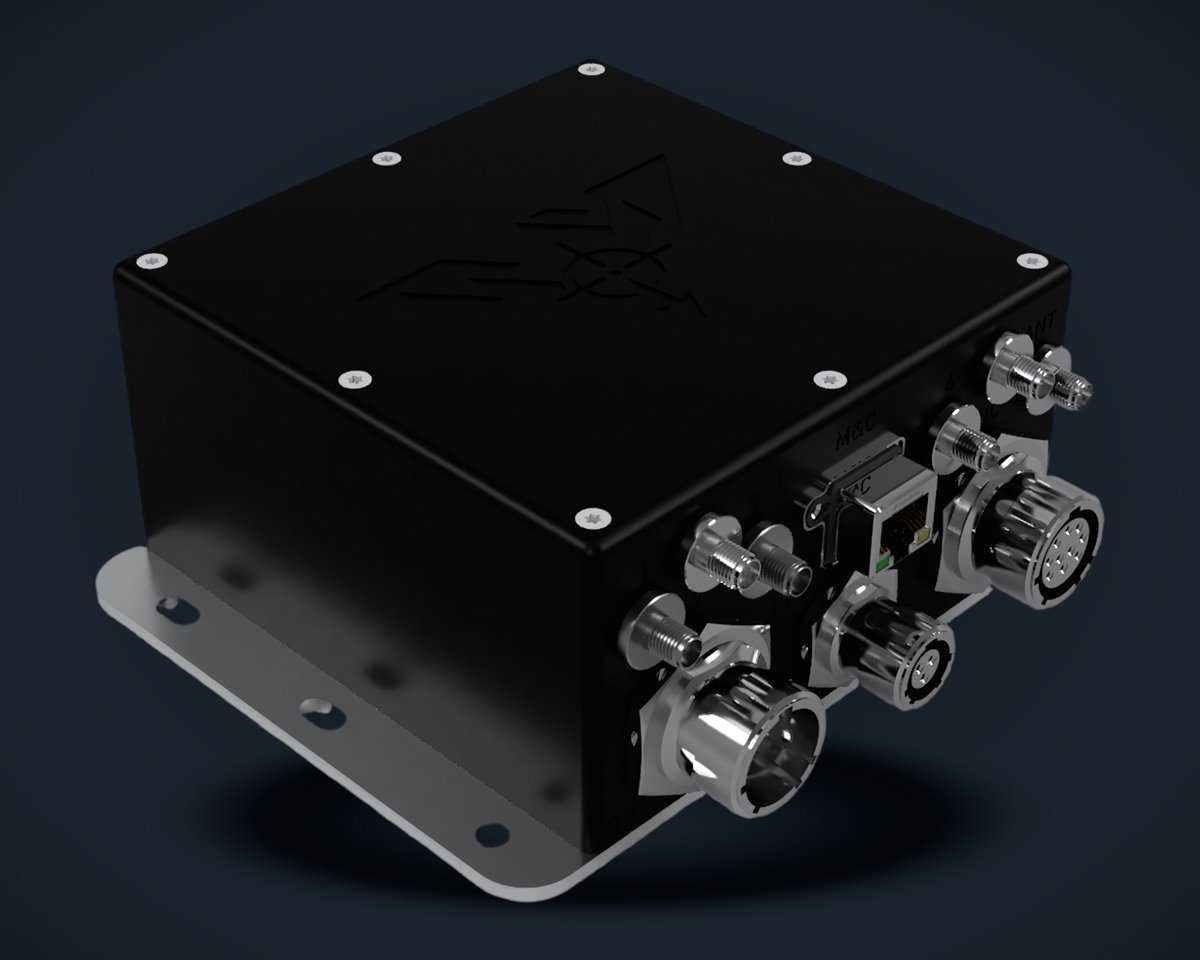
A 120 × 64 × 150 mm chassis, every interface on one face, bracket-mounted. No carrier, cabinet or rack required.
Select an image to enlarge it. These are renderings from the production CAD model; the NSN and serial number shown on the nameplate are illustrative.
Where It Operates
Used where time has to be common across subsystems, and verifiable.
Command & Control (C4ISR)
Command, control and intelligence architectures where separate subsystems must produce the same timestamp.
Naval Platforms
A single time source for shipboard radar, navigation and communications, in a chassis specified for salt fog and vibration.
Air Platforms
The 1.4 kg bracket-mounted chassis, designed to meet DO-160G for air platforms and ground stations.
Radar & Electronic Warfare
Four phase-coherent 10 MHz outputs feed radar and EW chains that depend on coherent processing.
Critical Infrastructure
Time distribution that survives GNSS outage in energy and transport control systems.
Telecom
PTP-based network synchronization for backbone and base station timing.
SARP - Secure · Accurate · Reliable · Precise
Every SARP product is built to reflect that.
Anti-jam and anti-spoof receiver, dual-band L1/L2, MIL-STD-461H electromagnetic compatibility.
GNSS-disciplined OCXO. Roughly 15 ns RMS while locked.
Holdover on signal loss, MIL-STD-810H chassis, under 25 µs drift across 24 hours.
Phase-coherent 4× 10 MHz, with IRIG-B and 1PPS distribution.
Request a Quote
RGMS is configured per project. Send us your requirements and the engineering team will put the configuration and the price together.
Quote Request Received
Your request has reached our engineering team. We will get back to you shortly.
Documents
The datasheet for technical evaluation, and a one-page overview for briefings and trade shows.